Packaging Specialists
Packaging | Healthcare | Moulding

How to Choose the Best PVC Factory for Global Sourcing?

Choosing the right Pvc Factory can shape your product quality, delivery schedule, and long-term sourcing costs. For global buyers, a low quotation is only one part of the decision. The factory should also prove its production capability, quality controls, and export experience. Look beyond polished brochures. Request recent product samples, factory photographs, test reports, and clear material specifications. A serious manufacturer can explain resin grades, additives, wall thickness, tolerance ranges, and testing methods without avoiding practical questions.

Evidence matters.

A dependable Pvc Factory should welcome a structured audit, whether conducted in person or through a qualified third party. Check extrusion equipment, mold maintenance, warehouse conditions, labeling systems, and final inspection records. Ask how defects are recorded and corrected. Review certifications carefully, and confirm whether they apply to the actual products and production site. Communication also deserves attention. Slow replies before an order may become serious delays after payment. Capacity, minimum order quantities, packaging standards, loading procedures, and backup plans should be documented clearly.

No supplier is perfect.

One factory may offer modern equipment but limited experience with your destination market. Another may provide excellent technical support but lack flexible production capacity. These differences require honest comparison, not assumptions. Consider shipping routes, customs documents, payment security, environmental practices, and after-sales response. A careful sourcing process reduces risk, although it cannot remove every uncertainty. The strongest choice is usually a transparent partner that provides consistent evidence, accepts reasonable inspections, and improves when problems are identified.
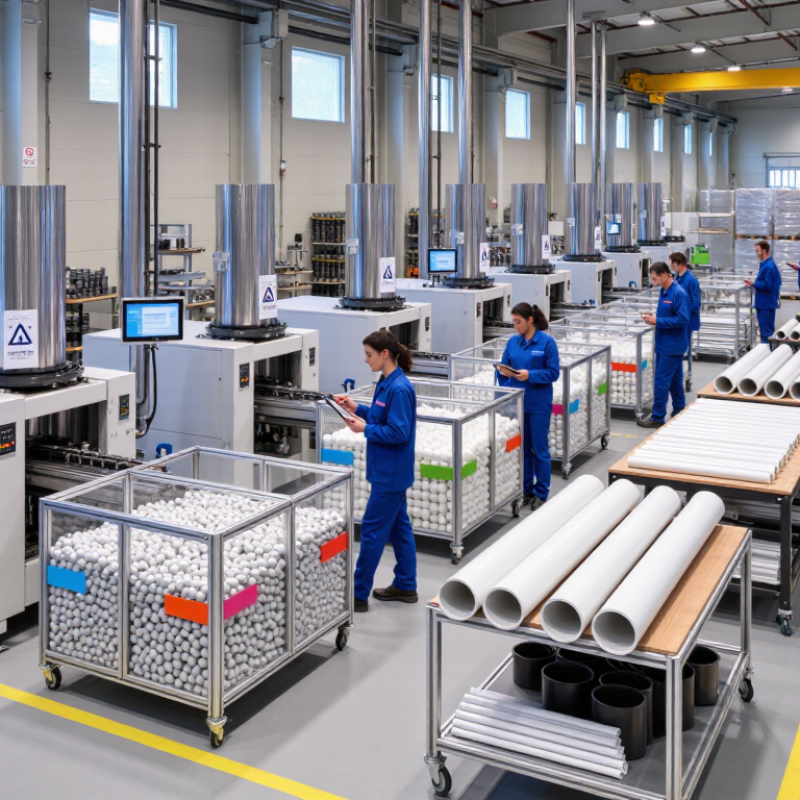
How to Choose the Best PVC Factory for Global Sourcing?

Defining Your PVC Sourcing Requirements and Quality Standards

Before contacting a PVC factory, define the product’s real working conditions.

State the application, dimensions, pressure, temperature, service life, color, and installation method. A pipe for outdoor use needs different controls from an indoor electrical profile. PlasticsEurope reported that PVC represented 12.7% of European plastics demand in 2022. This scale creates many suppliers, but not all offer equivalent formulations or process discipline.

Set measurable quality standards before comparing quotations.

Specify resin grade, K-value, plasticizer limits, density, tensile strength, impact resistance, Vicat softening temperature, and dimensional tolerances. For rigid PVC compounds, ASTM D1784 provides a useful classification framework.

Request batch-level certificates, test methods, retention samples, and traceability records. Factory audits should examine mixing logs, calibration records, laboratory equipment, and rejection rates. A clean showroom proves little.

Ask for samples made on the intended production line.

Check color consistency, surface marks, warpage, odor, and assembly fit. For outdoor products, include accelerated weathering and UV resistance tests.

UNEP’s 2023 report warned that global plastic waste could nearly triple by 2060 without stronger action, so recycled content and end-of-life requirements deserve early discussion. However, recycled PVC can affect consistency.

I have seen attractive samples fail after installation. That mistake is expensive.

A lower price may hide unstable additives, weak inspection, or incomplete documentation. Allow room for rethinking your specification after pilot testing.

Evaluating PVC Factory Capabilities, Certifications, and Experience

When choosing a PVC factory for global sourcing, evaluate its working capability beyond equipment lists. Ask for production flow records, monthly capacity, mold maintenance procedures, and quality checkpoints. A reliable factory should explain how it controls resin mixing, temperature, wall thickness, and surface defects. Request samples from different production batches, not only polished showroom pieces. Small details matter, such as consistent dimensions after cooling and clean, legible packaging labels.

Certifications can support trust, but they require careful checking. Confirm the certificate number, issuing body, scope, and expiry date independently. The document should cover the actual factory site and relevant PVC products. Ask whether testing follows the standards required in your destination market. Factory audits, material declarations, and test reports should match the shipped specification. A certificate alone proves little. That lesson is easy to overlook.

Experience is shown through repeatable performance, not years printed on a website. Review similar export projects, complaint records, corrective actions, and on-time delivery data. Ask how the team handles color variation, urgent changes, and failed inspections. A capable technical team will discuss limitations openly. That is reassuring. Buyers should also inspect labor, storage, and traceability systems through a live video call or site visit. Some evaluations remain imperfect because records can be incomplete. Document every assumption, then verify it before signing production terms.

Comparing Manufacturing Processes, Materials, and Product Customization

When choosing a PVC factory for global sourcing, study its manufacturing process, not only its catalog. Extrusion suits continuous profiles, tubing, and trim with stable cross-sections. Injection molding works better for complex fittings and repeatable details. Calendaring can produce thin sheets, but surface consistency requires careful temperature control. Ask to see process records, equipment maintenance logs, and sample inspection reports.

Material selection affects durability, safety, and cost. Rigid PVC may suit construction profiles, while flexible PVC needs controlled plasticizer selection. Request technical data for resin, additives, colorants, and recycled content. The factory should explain how it manages lead-free formulations and market-specific compliance testing. Small differences matter. A slight hardness change can affect sealing, bending, or installation.

Customization should begin with a practical drawing review. Confirm wall thickness, tolerances, mold-flow risks, color references, and packaging needs. A capable factory can recommend draft angles, stronger corners, or simpler tooling. It should also provide pre-production samples and batch traceability. Do not trust one perfect sample alone. Production may reveal warping, color variation, or uneven gloss. I have found that clear acceptance standards prevent more disputes than urgent corrections later. Some factories promise every feature, yet their process cannot hold the required tolerance. That is worth questioning.

How to Choose the Best PVC Factory for Global Sourcing?

Comparing common PVC manufacturing processes by production suitability, customization flexibility, and tooling intensity. Scores use a practical 1–5 sourcing scale, where 5 indicates a stronger advantage.

Extrusion is typically preferred for continuous products such as pipes, tubes, seals, and profiles. Injection molding is suited to complex, repeatable components but normally requires more tooling investment. Calendering is commonly used for PVC sheets, films, flooring, and coated materials where surface finish and thickness control are important. Final factory selection should also consider PVC formulation, compliance requirements, minimum order quantity, quality control, and export capability.

Assessing Pricing, Production Capacity, Lead Times, and Logistics

Choosing the best PVC factory requires more than comparing unit prices. Ask for a cost breakdown covering resin, additives, electricity, tooling, packaging, and delivery terms. A low quotation may hide unstable material quality or expensive rework. I would challenge any quote that excludes tooling maintenance and inspection costs.

Production capacity must match your forecast, not only your first order. Request monthly output, current utilization, backup equipment, and recent production records. A factory producing 800 tonnes monthly may have little capacity during seasonal demand. Check whether your order receives a fixed production slot. Confirm lead time in writing, including sampling, tooling, production, inspection, and export preparation. The World Bank Commodity Markets Outlook highlights continuing commodity price volatility, so fixed pricing should include a clear validity period.

Tips: Build a landed-cost comparison for three factories. Measure production days separately from shipping days. UNCTAD’s Review of Maritime Transport 2024 reports that global seaborne trade reached about 12.3 billion tonnes in 2023. Port congestion and route changes can still disrupt schedules. Ask for booking records, estimated port dwell time, container loading photos, and a shipment-tracking process. The World Bank Logistics Performance Index 2023 emphasizes customs, infrastructure, tracking, and timeliness. These details expose weak logistics earlier. Perfect forecasts are unrealistic. Review the plan monthly.

Verifying Factory Reliability Through Audits, Samples, and Contracts

Choosing a PVC factory for global sourcing requires evidence, not polished presentations. A reliable audit examines production capacity, process control, worker safety, and traceability. Request recent records for incoming resin, additives, and finished goods. Walk the floor, if possible. Look for labeled batches, calibrated gauges, clean storage, and maintenance logs. Empty shelves can be a warning. So can unexplained rework.

Samples should represent normal production, not a specially prepared batch. Ask for several pieces from different runs. Check dimensions, color consistency, flexibility, surface finish, and odor against written specifications. For demanding applications, use an independent laboratory for tensile strength, aging, migration, or other relevant tests. Keep sealed reference samples with dates and batch numbers. A sample can pass while the factory fails later. That risk needs attention.

Contracts turn verbal confidence into measurable responsibility. Define material grades, tolerances, inspection methods, packaging, delivery terms, change approvals, and document retention. Include a clear process for nonconforming goods, corrective actions, and reinspection. Specify which party pays for verified failures. Protect design files and confidential production information. I once treated a friendly factory visit as stronger evidence than it deserved. The order later exposed weak batch records. My mistake was trusting impressions without checking continuity. A second audit before scale-up may feel slow, but it can reveal gaps that samples never show.

Article Source: