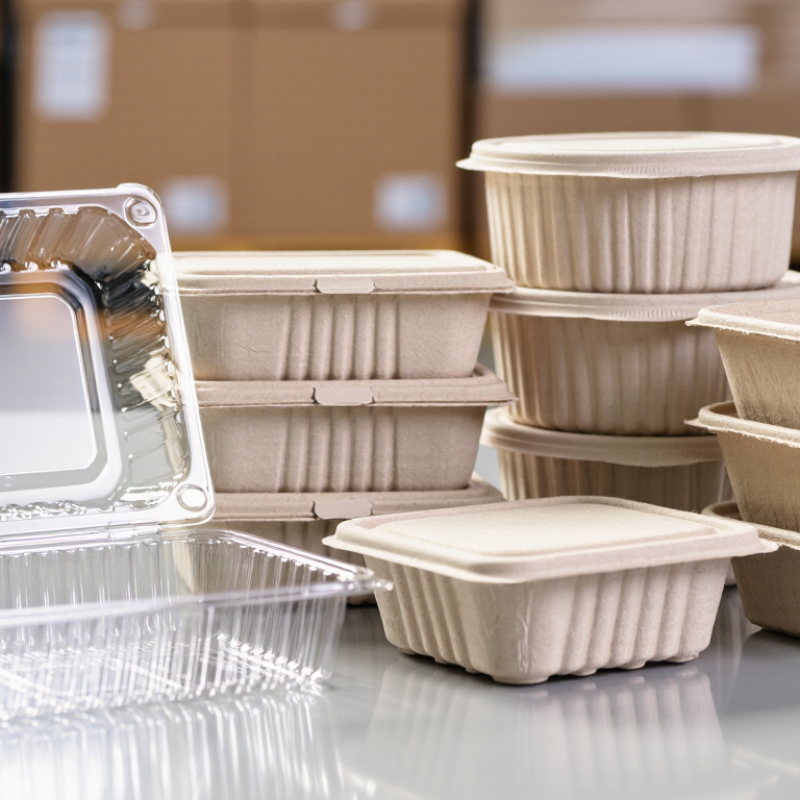
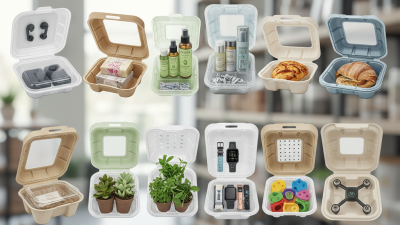
| Clear PET / APET Clamshell |
0.25–0.80 mm |
PET sheet extrusion followed by plug-assist or vacuum thermoforming; trim waste is removed and the lid may be hinged in-line. |
High clarity, good impact resistance, strong product visibility, moderate barrier performance, and reliable heat sealing. |
Produce, bakery items, small hardware, household accessories, toys, and retail gift items. |
Widely recyclable where PET rigid packaging collection and sorting are available. The hinged format should remain free from incompatible materials and heavy coatings. |
Confirm food-contact compliance, recycled-content percentage, sheet gauge tolerance, clarity standard, hinge-cycle requirements, and access to local PET recycling streams. |
Typical forming range is approximately 120–170°C, depending on sheet grade, gauge, mold design, and equipment. |
| Recycled PET / RPET Clamshell |
0.30–0.80 mm |
Recycled PET flake or pellet preparation, sheet extrusion, drying, and thermoforming. Multi-layer sheet structures may be used to improve appearance or processing stability. |
Good transparency and stiffness; optical quality, odor, and color can vary with feedstock quality and recycling controls. |
Fresh produce, bakery packaging, personal-care accessories, electronics accessories, and general retail products. |
Generally compatible with PET recycling systems. Recyclability depends on local infrastructure, additives, labels, adhesives, pigments, and the final package design. |
Request a verified recycled-content declaration, mass-balance or physical-content documentation where applicable, food-contact evidence, color limits, and batch-to-batch appearance controls. |
Thermoforming conditions are broadly similar to virgin PET, but drying and moisture control are especially important to reduce brittleness and haze. |
| Polypropylene / PP Clamshell |
0.35–1.00 mm |
Cast or extruded PP sheet followed by thermoforming; injection molding is also used for thicker hinged containers and integrated locking features. |
Lightweight, fatigue-resistant hinge performance, good chemical resistance, and better heat resistance than many common packaging plastics. |
Hot or warm food applications, household products, stationery, tools, cosmetics accessories, and reusable retail packaging. |
Recyclable in regions that collect rigid PP. Clear and natural grades are generally easier to sort than heavily pigmented or multilayer structures. |
Check hinge durability, sealing temperature, warpage, food-contact status, recycled-content availability, and whether the destination market accepts rigid PP packaging. |
Sheet forming commonly uses higher temperatures than PET; exact settings depend on PP grade, crystallinity, sheet thickness, and mold cooling. |
| Polylactic Acid / PLA Clamshell |
0.30–0.75 mm |
PLA resin or sheet extrusion followed by thermoforming. Crystallized or heat-resistant grades may be selected for improved dimensional stability. |
High clarity and bio-based origin; comparatively limited heat resistance and potential brittleness under unsuitable storage or impact conditions. |
Cold food, bakery products, fresh produce, promotional packaging, and applications where industrial composting is available. |
Industrial compostability may be possible when the package meets applicable requirements such as EN 13432, ASTM D6400, or equivalent rules. It is not automatically suitable for home composting or conventional plastic recycling. |
Verify certification, composting route, temperature limits, shelf-life requirements, migration testing, and destination-country labeling rules before purchase. |
Processing windows are narrower than for many conventional plastics; drying, mold temperature, and demolding control are important. |
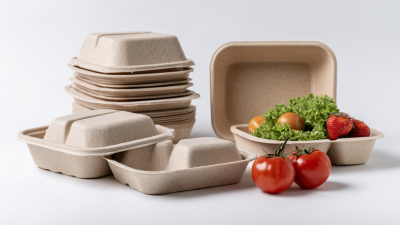
| Molded Fiber / Bagasse Clamshell |
1.5–4.0 mm wall thickness |
Pulp preparation, wet forming or thermoformed fiber molding, hot pressing, drying, trimming, and optional barrier coating or treatment. |
Good rigidity, renewable-fiber appearance, moderate thermal performance, and lower transparency. Moisture and grease resistance depend strongly on coatings. |
Takeaway food, bakery items, produce, agricultural products, and protective packaging for non-fragile goods. |
May be recyclable in paper or compostable through appropriate systems, but plastic or fluorinated barriers can change the disposal route. Certification and local mill acceptance should be checked. |
Control moisture content, odor, pulp source, coating chemistry, microbial limits for food use, dimensional shrinkage, and container nesting during shipment. |
Drying and hot-press stages often use elevated temperatures; cycle time is influenced by wall thickness, moisture level, mold geometry, and drying capacity. |
| Paperboard Folding Clamshell |
0.35–0.75 mm board caliper |
Paperboard coating or printing, die-cutting, creasing, folding, gluing, and optional transparent window or locking tab assembly. |
Good printability, efficient flat shipment, lightweight construction, and lower moisture resistance unless coated or laminated. |
Retail accessories, confectionery, stationery, small consumer goods, and lightweight gift products. |
Usually recyclable in paper streams when free from incompatible laminates, excessive coatings, plastic windows, and food contamination. |
Specify board grade, recycled-fiber percentage, coating type, ink and adhesive suitability, color tolerances, compression strength, and flat-pack moisture protection. |
Die-cutting and folding are high-speed processes; design approval should include crease cracking, locking strength, glue cure, and automated packing compatibility. |
| PVC Clamshell |
0.25–0.70 mm |
PVC sheet extrusion followed by vacuum or pressure thermoforming; heat sealing, RF sealing, or mechanical locking may be used. |
Good clarity, stiffness, and cost efficiency, with material and additive restrictions that vary substantially by market. |
Some non-food retail, hardware, stationery, and display packaging applications where permitted. |
Collection and recycling are less consistent than for PET or PP. Chlorine-containing material and additives may create additional regulatory and end-of-life considerations. |
Review destination-market restrictions, chemical compliance, plasticizer status, incineration requirements, food-contact rules, and retailer packaging policies before selection. |
Thermoforming settings depend on rigid or flexible PVC formulation; avoid overheating and confirm dimensional stability after forming. |